

Executive Talent Magazine
For senior executives, landing a first board seat often requires more than an impressive career record. It requires understanding how boards think, how director needs are defined, and how candidates are evaluated against the company’s future strategy.
At the AESC Global Summit on Leadership in New York City, executive search and leadership advisory experts offered a practical look inside the board appointment process. Drawing on their experience advising boards and assessing senior leaders, the panel explored what boards are really looking for, how executives can position themselves for board service, and why the path to a board seat begins with one central question: how will you add value in the boardroom? Their insights are equally relevant for the search and advisory professionals who guide candidates through this process, as well as for those considering a first board seat themselves.
Boards Are Hiring for the Future
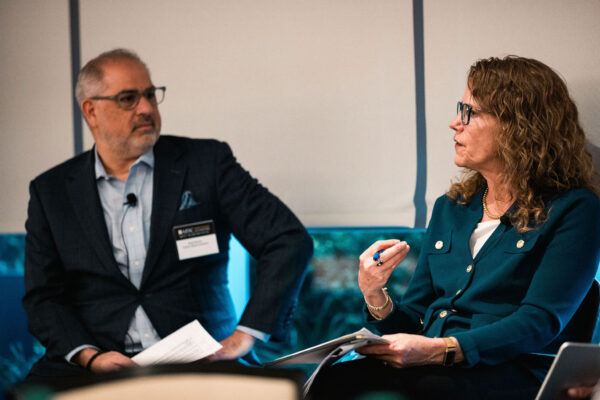
Greg Gerson and Lauren Smith speak at the How to Land Your First Board Seat panel
Board seats open for a range of reasons. Some directors retire. Some boards expand. In other cases, boards identify a gap in the expertise they need to guide the organization forward.
From the perspective of executive search advisors, the strongest board searches begin not with a vacant seat, but with a strategic question: where is the organization going, and what capabilities will the board need to help guide that future?
Lauren Smith, Managing Partner and Co-Head, Board Practice, DSG Global, explained that while some boards may replace a retiring director with someone who has a similar profile, the best board searches are more forward-looking.
“The best boards are looking for where the organization is going and what they are missing on the board,” Smith said. “What is the industry expertise? Do we have the cyber knowledge to navigate through today’s times?”
That future-facing lens is critical for aspiring directors and for the boards assessing them. Rather than asking only whether a candidate has the right title, boards must consider whether that leader can add meaningful value to the company’s next chapter.
Matrice Ellis-Kirk, Chief Executive Officer, Ellis Kirk Group, noted that boards often look for leaders with C-suite experience, qualified financial expertise, compensation knowledge, or domain expertise tied to the company’s strategic direction. In many cases, she said, boards are thinking 18 months to three years ahead and considering what skills will be needed to accomplish future goals.
“More times than not, they’re looking for people who understand how to drive business decisions inside those businesses and can add value,” Ellis-Kirk said.
For executive search and leadership advisory consultants, this is where the work becomes highly strategic. Effective board search is not simply about identifying available candidates. It is about helping boards clarify future needs, understand the market, and evaluate leaders against the capabilities, experience, and judgment required for long-term governance.
Translating Executive Experience Into Board-Level Value
For executives pursuing board service, the challenge is not simply to summarize what they have done. It is to explain why that experience matters at the board level.
That distinction is central to the work of executive search advisors. The strongest board candidates are not always those with the most recognizable titles. They are the leaders who can connect their experience to enterprise impact and demonstrate how their perspective will help a board govern more effectively.
Emilie Seyfang, Solutions Partner Consultant, Hogan Assessments, emphasized the role of strategic self-awareness. While experience and skills matter, she said, personality traits, values, and behavioral tendencies can also shape how someone contributes in a board setting.
“We call it strategic self-awareness,” Seyfang said. “I know myself, I know what I bring to the table, I know the unique skills and kind of experiences and tendencies that I have that would contribute to this board.”
That self-awareness can help executives define their differentiated value. Smith encouraged leaders to think broadly about what they bring, not only role experience, but also industry knowledge, networks, regional influence, and the ability to help a company achieve a specific strategic goal.
Ellis-Kirk described her own experience preparing for her first board role, a private equity portfolio company board. The exercise required her to reframe her accomplishments through a broader enterprise lens.
“I had to think about it more, not what my P&L was, but what did my P&L do for the company?” she said. “How did I help to increase margin? What did I do to build that company infrastructure?”
That shift, from functional responsibility to enterprise contribution, is often what separates a strong executive resume from a compelling board narrative. It is also at the heart of what BlueSteps’ board package is designed to address, helping candidates translate operating experience into a governance-ready story. For boards and their search advisors, the question is not only what a leader has managed, but how that leader’s experience can help the board address the organization’s most important opportunities and risks.

Matrice Ellis-Krik and Emilie Seyfang listen as Greg Gerson addresses the room.
Board Search Is About More Than Credentials
The panel also underscored why board search is a nuanced advisory discipline. Skills and titles may get a candidate into the conversation, but judgment, values, culture, and boardroom presence often determine whether they are selected.
Smith noted that many clients still focus heavily on skills, background, and scope of experience. Boards may look for executives who have worked at companies of similar or larger size, leaders with P&L experience, or candidates with specific functional expertise. But cultural fit remains an essential part of the process.
Ellis-Kirk agreed, adding that assessment tools can be especially useful when boards are thinking proactively about the future composition of the board, how directors will work together, and how the board will evolve as members age out or turn over.
Seyfang expanded on the point, noting that values shape how leaders make decisions, solve problems, and contribute to culture.
“It’s not just the personality, what are my natural tendencies, who do I become under stress and pressure, but also what do I value,” she said.
For AESC Member executive search and leadership advisory firms, this is a core part of the value they bring. Board recruitment is not only about matching a skills matrix. It is about understanding the company’s strategy, the board’s dynamics, the candidate’s motivations, and the behaviors that will help or hinder effective governance.
Show Up as a Peer, Not a Job Candidate
Because executive search consultants sit between boards and candidates, they often see a gap that candidates themselves may miss: the difference between being impressive and being seen as board-ready.
One of the most common mistakes aspiring directors make is approaching a board interview like an executive job interview.
Ellis-Kirk said she often sees candidates with outstanding qualifications fall short because they do not present themselves as strategic partners.
“The biggest thing that they come back with is, I really liked that person. I want to hire them, but I didn’t see them as being a strategic partner to the business,” she said, describing common client feedback.
For board candidates, the audience is not evaluating whether they can manage a function. They are assessing whether the candidate can contribute as a peer in the boardroom, particularly when decisions are complex or high stakes.
Smith built on that point, noting that executives spend much of their careers interviewing for roles where they would report to someone. A board interview is different.
“You’re interviewing as a peer,” Smith said. “You need to see yourself as a peer, even how you show up, how you interact.”
That also means changing “hats” at the door. The board role is one of oversight, not management. Candidates who go too deep into operational detail, ask “gotcha” questions, or try to prove expertise through minutiae can undermine their candidacy.
For boards, this distinction matters. Executive success does not automatically translate into board effectiveness. Directors must know how to provide oversight without stepping into management, how to challenge without derailing, and how to contribute as peers. Experienced executive search advisors understand this difference and help boards assess not only whether a candidate has led, but whether they are prepared to govern.
Preparation Can Set Candidates Apart
Board candidates are expected to do their homework. But the panelists emphasized that strong preparation goes beyond reading public filings or scanning the company website.
Smith advised candidates to listen to earnings calls rather than only reading transcripts.
“Listen to the tone of the CEO,” she said. “Listen to what the conversation is like. Listen to what the analysts are asking.”
For consumer companies, she suggested studying competitors and even engaging directly with the product or customer experience. The goal is not to demonstrate encyclopedic knowledge, but to ask informed, strategic questions that reflect a board-level understanding of the business.
Greg Gerson, Founder and CEO, Fusion Search Partners, reinforced the point, noting that candidates should look for interviews, videos, analyst commentary, and other materials that help them understand the company, its leaders, and its culture.
Ellis-Kirk offered one caution: do not begin the conversation too socially.
“Don’t start there,” she said. “You can always end there, put it in a parade in the middle, but don’t start there because then you’re going to be the person that they want to go have a drink with, but don’t want on the board.”
For search advisors, preparation is one signal of how a candidate will operate in the boardroom. The strongest candidates demonstrate curiosity, judgment, and the ability to frame thoughtful questions at the right level.

From Left: Greg Gerson, Lauren Smith, Matrice Ellis-Kirk, and Emilie Seyfang
Networks Matter, and So Does Visibility With Search Advisors
For many executives, the biggest question is how to get surfaced for board opportunities in the first place.
Ellis-Kirk pointed to the importance of networks, noting that many board opportunities are identified through relationships. Her advice: start with people already serving on boards. Ask how they see your readiness, where they believe you could add value, and whether there are others in their network you should meet.
She also encouraged executives to lean into thought leadership.
“You are a thought leader in an area,” she said. “Lean into that and leverage it.”
That could include publishing, speaking, sharing insights, and making sure the market understands where the executive has distinctive expertise.
Director education organizations such as NACD also play a meaningful role in the broader ecosystem, supporting aspiring directors with governance training, peer community, and visibility within the director market.
The panel also emphasized the importance of relationships with executive search consultants. Ellis-Kirk advised executives who already know someone in executive search to ask for introductions to colleagues who specialize in board work, noting that board search may sit with different people inside a firm.
Smith recommended that executives currently inside an organization begin with their CEO. A CEO can offer candid feedback on readiness, help articulate the executive’s value proposition, and support a more focused board narrative. She also recommended speaking with current board members and refining the message from “I want to sit on a board” to a more precise explanation of the kind of board where the executive can add value.
LinkedIn also matters. Smith noted that board committees often look at a candidate’s profile quickly after a name is raised.
“Yes, you need a board bio. Yes, you need a resume, but LinkedIn is still really important,” she said.
For executives, visibility is not about broad self-promotion. It is about making one’s board value clear, credible, and easy to understand. For boards, trusted search partners can help expand the candidate pool beyond familiar networks and identify leaders whose experience aligns with the organization’s future needs.
The First Board Seat Starts With a Clear Story
The path to a first board seat is rarely linear. But the panelists made clear that executives can improve their chances by doing three things well: understanding the needs of boards, defining their board-level value, and communicating that value through a strategic lens.
That requires more than listing accomplishments. It requires showing how those accomplishments helped an enterprise grow, adapt, compete, or transform. It requires preparation that reflects curiosity and judgment. And it requires the ability to enter the room not as a candidate seeking approval, but as a potential peer ready to contribute.
For those considering their own path to a first board seat, BlueSteps’ Modern Board Candidate’s Playbook explores these themes in greater depth. It is a free, downloadable resource for executives thinking seriously about board service.
For boards, the discussion reinforced the value of working with trusted executive search and leadership advisory partners. AESC Member firms bring market insight, assessment rigor, and a deep understanding of board dynamics to one of the most consequential leadership decisions an organization can make: who earns a seat at the table.
As Smith put it, the central question is: “How are you going to add value to whatever organization board you’re going after?”
