
Executive Talent Magazine
The CEO role has never been easy. But the pressures facing today’s chief executives—activism, AI disruption, geopolitical volatility, stakeholder scrutiny, and accelerated expectations for results—are changing not only what CEOs must do, but how boards must think about CEO succession.
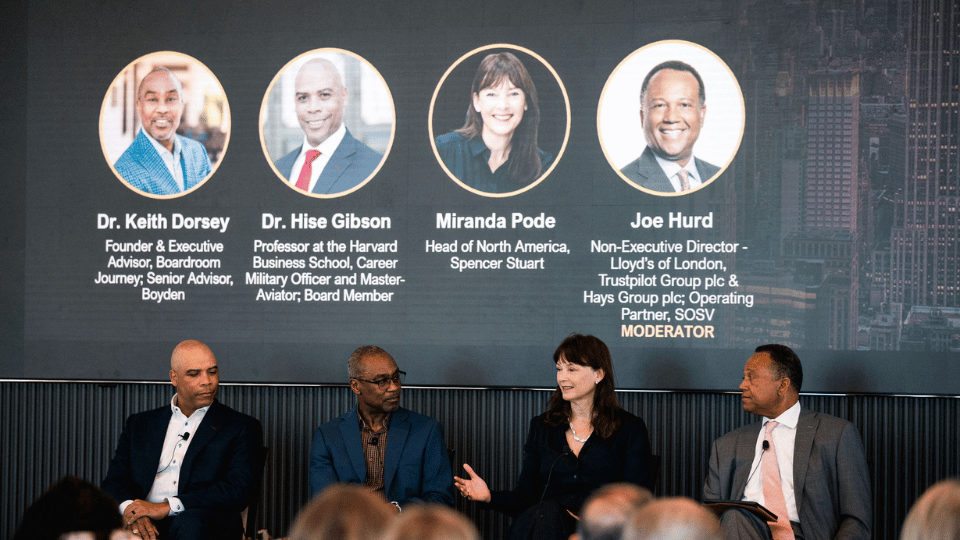
At the AESC Global Summit on Leadership in New York City, panelists explored what the CEO of 2030 will require and how boards, supported by executive search and leadership advisory partners, can identify leaders prepared for a more complex future. Moderated by Joe Hurd ( Non-Executive Director – Lloyd’s of London, Trustpilot Group plc & Hays Group plc; Operating Partner, SOSV), the session featured Dr. Keith D. Dorsey (Founder and Executive Advisor, Boardroom Journey; Senior Advisor, Boyden), Dr. Hise O. Gibson (Professor at the Harvard Business School; Career Military Officer and Master-Aviator; Board Member) and Miranda Pode (Head of North America, Spencer Stuart) in a wide-ranging conversation about CEO churn, board refreshment, cognitive diversity, AI fluency, and the danger of defaulting to yesterday’s leadership models.
Their message was clear: finding the CEO of 2030 will require boards and search advisors to challenge old assumptions, ask better questions, and assess not only experience, but adaptability, courage, curiosity, and the ability to lead through uncertainty.
The CEO Role Is Under New Pressure
Miranda Pode, Head of North America, Spencer Stuart
Miranda Pode opened the conversation by describing a rise in CEO churn. Some of that movement, she noted, reflects a return from the unusually low levels of CEO turnover seen during the COVID period. But other forces are also at work.
“We’re seeing a rise in activism,” Pode said, adding that a large proportion of CEOs who stepped down in the last year or two did so amid pressure from activist investors.
That pressure is not evenly distributed. Pode pointed to data suggesting that activists are targeting female CEOs at higher rates, raising questions about how boards defend and support the leaders they appoint. She also described a broader environment of short-term thinking, constant scrutiny, and relentless demand for results.
“We’re in the age where everybody knows everything and half of it’s not real,” she said. “The pressure’s huge.”
For executive search advisors, this context matters. CEO succession can no longer be viewed simply as a process of finding a proven operator with a familiar profile. Boards need leaders who can withstand pressure, communicate through ambiguity, manage multiple stakeholder groups, and make decisions in an environment where scrutiny is constant and information moves faster than ever.
Boards Must Rethink What “Ready” Looks Like
One of the session’s most important themes was the gap between how boards have traditionally selected CEOs and what the future may require.
Pode noted that many CEOs leave before they reach the point at which they may be positioned to deliver transformational impact. According to Spencer Stuart research discussed in the session, many CEOs depart at five years or under, even though five years may be when they begin to “hit their stride.” She also described an 18-month “danger zone,” when boards may begin to lose confidence in a newly appointed CEO.
That raises a critical question for boards: are they setting CEOs up for success, or expecting unrealistic outcomes too quickly?
Pode challenged boards to examine their own role in CEO success.
“How much were we actually coaching and guiding the individual?” she asked. “How realistic were we in our expectations of what they would do?”
This is where executive search and leadership advisory firms can add significant value. The work does not end with identifying a candidate. Search advisors can help boards define realistic success factors, clarify expectations, assess leadership readiness, and support a more thoughtful transition into the role.
For the CEO of 2030, readiness may not look like a linear résumé or a familiar path. It may look like the ability to learn quickly, build trust under pressure, and make sound decisions when the old playbooks no longer apply.
Move Beyond the “Doppelganger” CEO
Dr. Keith D. Dorsey warned that too many boards are returning to familiar patterns—seeking CEOs who resemble the leaders who came before them.
Dr Keith Dorsey, Founder and Executive Advisor, Boardroom Journey; Senior Advisor, Boyden, speaks to the crowd
“What got you here won’t get you there,” Dorsey said. “This world is changing at such a pace that we have to, as search professionals, change right along with them.”
He argued that boards and search professionals must challenge the instinct to recruit “doppelgangers” of prior CEOs. Instead, they need to understand the company’s strategy, the future operating environment, and the leadership capabilities required for what comes next.
“We have to challenge… the existing thinking that is going on out there,” he said, calling on board chairs, nominating and governance committees, and search professionals to seek “disconfirming evidence” and ensure that boards are selecting leaders “right for the strategy.”
This is a powerful AESC Member-firm connection. The value of executive search is not simply access to candidates. It is the ability to act as a trusted advisor: to push beyond comfort zones, bring market intelligence into the boardroom, and help clients test whether their assumptions align with the future they are trying to build.
The CEO of 2030 Must Be a Learner, Not a Hero
The conversation also challenged the long-standing image of the CEO as an all-knowing heroic leader.
Dorsey argued that traditional skills metrics often focus on what is visible: functional experience, prior roles, and sector knowledge. But he cautioned that these may represent only “the 10% of the iceberg” above the surface. Beneath the surface are the competencies that matter most in a changing world: curiosity, courage, agility, emotional intelligence, and the ability to handle adversity.
“Right now, CEOs of the past, we used to look for heroes,” he said. “Right now, we need to look for learners.”
That shift has major implications for CEO search. Boards may still need to evaluate experience, scale, industry relevance, and financial performance. But the CEO of 2030 will also need the humility and agility to learn continuously, adapt rapidly, and lead through conditions they may never have encountered before.
For executive search firms, this means helping boards assess not only what candidates have achieved, but how they think, how they learn, how they recover from setbacks, and how they respond when the answers are not obvious.
AI Fluency and the Ability to Slow Down
Dr. Hise O. Gibson introduced the idea that the leadership environment has moved beyond VUCA (volatile, uncertain, complex, and ambiguous) into what he described as a BANI world: brittle, anxious, nonlinear, and incomprehensible. In an era shaped by AI and accelerating technological change, he argued, leaders need more than familiarity with tools. They need AI fluency and the ability to apply knowledge to new problems.
In this environment, Gibson said, one of the most important capabilities may be the ability to slow down.
Dr. Hise Gibson, rofessor at the Harvard Business School; Career Military Officer and Master-Aviator; Board Member
“You need folks who are able to slow things down,” he said. “If you’re able to slow down and take a long-term tactical pause, whenever problems arise, take a pause.”
That advice runs counter to the instinct many leaders have in moments of crisis: move faster, act immediately, run toward the problem. But Gibson argued that the CEO of 2030 must be able to pause, process, and make thoughtful decisions amid uncertainty.
For boards and search advisors, the practical question becomes: how do you assess that capability?
Gibson suggested looking differently at career paths, including the breaks and disruptions that may have shaped a leader’s adaptability. A résumé with no breaks, he suggested, may not always be a sign of strength. Leaders who have had to reinvent themselves may bring precisely the resilience and pattern recognition needed for the future.
This creates an opportunity for executive search firms to help boards look beyond traditional markers of readiness. The CEO of 2030 may not have the most conventional path. But they may have demonstrated the capacity to adapt, rebuild, and lead through complexity.
Optimal Diversity as a Business Imperative
The panel also explored how boards should think about diversity in a polarized environment.
Dorsey described “optimal diversity” as the combination of observable diversity and cognitive diversity. The goal, he said, is not diversity for its own sake, but better decision-making through different perspectives.
“It’s really about differing perspectives,” Dorsey said, adding that different perspectives help boards ask better questions, mitigate risk, and identify opportunities.
He acknowledged that diverse perspectives can slow decision-making because people ask different questions. But that, he argued, may ultimately help boards arrive at better outcomes.
For CEO succession, this is especially important. If boards select leaders through narrow networks or familiar archetypes, they may miss candidates with the perspectives needed to guide the organization through new forms of disruption. AESC Member firms can help broaden the aperture, introduce rigor to candidate evaluation, and ensure that “merit” is understood in relation to the company’s future—not merely its past.
Board Refreshment Is Part of CEO Succession
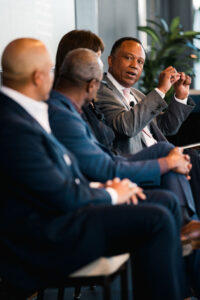
Joe Hurd, Non-Executive Director – Lloyd’s of London, Trustpilot Group plc & Hays Group plc; Operating Partner, SOSV, moderates the panel
The panel made clear that identifying the CEO of 2030 is not only a question of who is being hired. It is also a question of who is doing the hiring.
Dorsey argued that boards themselves must be prepared to think differently. He pointed to long-tenured directors who may not have been active executives for many years and questioned whether they are equipped to assess the leadership needs of a rapidly changing environment.
Pode added that many boards approach CEO succession with fear. The stakes are high, and CEO succession is one of the few decisions boards make without the CEO guiding them. That is precisely why boards need experienced advisors, current data, and structured processes.
“Most of the boards I speak to when we’re doing CEO successions are absolutely terrified by getting it wrong,” Pode said.
The point is clear: boards need trusted guidance. CEO succession is too consequential to be driven by habit, fear, or nostalgia for prior leadership models.
Executive search and leadership advisory firms are uniquely positioned to help boards navigate that moment. They can bring external perspective, market data, assessment expertise, and the courage to ask difficult questions when boards may be tempted to choose the safest or most familiar option.
Finding the CEO of 2030
The CEO of 2030 will not be found by looking only for the CEO of yesterday.
The next generation of chief executives will need to lead through activism, AI disruption, geopolitical uncertainty, stakeholder pressure, and rapid change. They will need to be learners rather than heroes. They will need the courage to make difficult decisions, the humility to adapt, and the judgment to pause when the world demands speed.
For boards, that means CEO succession must become more future-focused, more rigorous, and more open to different forms of leadership potential. For executive search and leadership advisory firms, it means playing the role of strategic partner: challenging assumptions, widening the aperture, assessing deeper competencies, and helping boards define what leadership readiness truly means for the decade ahead.
As Dorsey told the audience, “What got you here won’t get you there.”
That may be the central challenge of CEO succession today and the central opportunity for AESC Member firms advising the boards that must get it right.
