
Executive Talent Magazine
The role of the CEO has always carried pressure. But today, that pressure is intensifying and the runway for success is getting shorter.
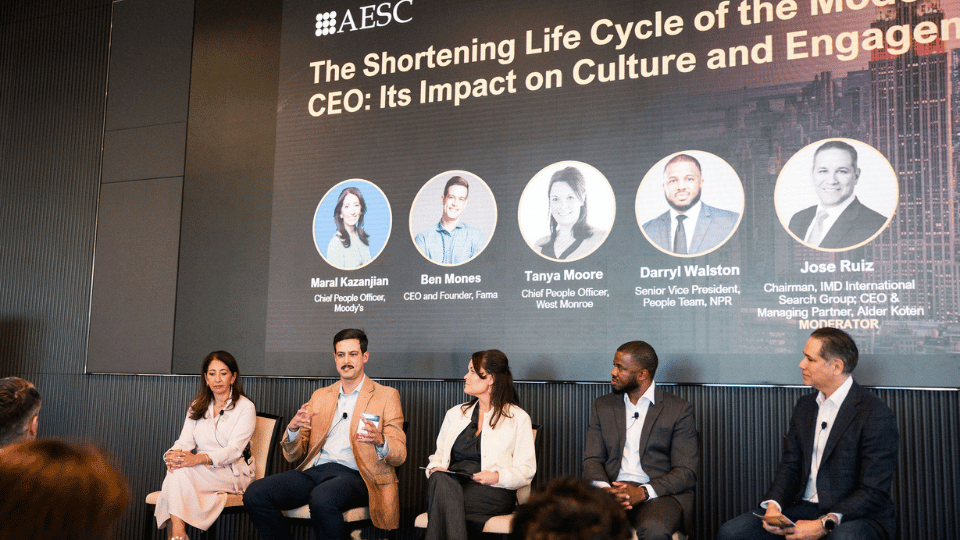
At the AESC Global Summit on Leadership in New York City, a panel on “The Shortening Life Cycle of the Modern CEO: Its Impact on Culture and Engagement” explored how shifting expectations, compressed timelines, increased scrutiny, and unexpected disruption are changing what organizations need from chief executives. Moderated by Jose Ruiz, Chairman of IMD International Search Group and CEO & Managing Partner of Alder Koten, the conversation featured Maral Kazanjian, Chief People Officer of Moody’s; Ben Mones, CEO and Founder of Fama; Tanya Moore, Chief People Officer of West Monroe; and Darryl Walston, Senior Vice President, People Team at NPR.
Together, they examined a question with significant implications for boards, leadership teams, and executive search advisors: how do you identify a CEO who can lead not only against today’s strategy, but through the unknowns that may redefine that strategy altogether?
Their answers centered on judgment, adaptability, cultural alignment, and the shared responsibility required to help a CEO succeed.
When the Strategy Breaks

Darryl Walston speaks about his experience at NPR.
In executive search, much of the early work centers on alignment: defining the role, clarifying expectations, and building a position specification that reflects what the board believes the next leader must accomplish.
Ruiz framed that work as one of the most important responsibilities of search consultants: clarifying expectations up front. Sometimes, he noted, that means finding a CEO to execute a strategy already defined by the board. Other times, it means finding a leader who can set, renovate, or transform strategy. But he posed a more difficult question: “What happens when the strategy breaks?”
Walston answered with NPR’s own CEO transition. The organization hired a new CEO with a clear strategic direction, only to face a major external disruption that changed the mandate almost immediately. Suddenly, the first months of leadership became less about executing the original plan and more about firefighting, pivoting, and helping the organization navigate unfamiliar terrain.
“You have a plan and you have a roadmap, and then you get hit with something that is totally outside of their control, outside of our control,” Walston said.
The result, he explained, was that the traditional timeline for evaluating CEO success had to shift. “You lose your first 90 days out the window because you are a firefighter,” he said. “Your first six months, that plan changes. Your first year, that plan changes.”
For boards and executive search advisors, the implication is clear: the role specification must go deeper than the expected business plan. It must account for the leader’s ability to adapt when the environment changes, when assumptions no longer hold, and when culture and engagement become essential to organizational resilience.
CEO Success Is a Shared Responsibility
The NPR example also illustrated the importance of board support.
Ruiz noted that NPR’s situation could have become “catastrophic,” a scenario in which a CEO might last one year or less.
“I think that showed the benefit of having a strong board who would stand by their decision and their leader,” Walston said. He added that the board had to return to the reasons the CEO had been selected and remain aligned around its vision for the organization.
That matters because CEO success is not created by the CEO alone. The board is part of the institution. Its expectations, alignment, communication, and support all shape whether a CEO can lead effectively, especially through disruption.
Tanya Moore later made a similar point about the relationship between companies and their search partners. “I very much think it’s a shared responsibility,” she said. “I don’t think you all can do your job if we don’t do ours, if we don’t collectively gain alignment through the process, if we’re not really candid about what’s actually going on.”
For executive search advisors, this reinforces the importance of candor at the start of a search. Search firms can help boards clarify what they want a CEO to do, but organizations must also be honest about culture, internal dynamics, stakeholder expectations, and the realities the next leader will inherit.

Jose Ruiz
Judgment May Be the Defining CEO Capability
The more uncertainty organizations face, the more important judgment becomes.
Ruiz connected this directly to the work of search consultants. Depending on the CEO’s expected mandate, a search may focus on skills, competencies, culture-shaping ability, strategy transformation, or something deeper. He called judgment “the only thing that remains when anything is out the window.”
That idea is especially relevant to CEO succession today. Boards can evaluate what candidates have done before, but the modern CEO will inevitably face scenarios that do not appear in a résumé: Funding shifts. Stakeholder expectations change. Public scrutiny intensifies. Technology alters the business model. Culture fractures under pressure.
The question becomes not simply, “Has this person done the job before?” but “How does this person make decisions when the playbook no longer applies?”
For executive search and leadership advisory firms, this is a critical opportunity to add value. Through structured assessment, deep referencing, stakeholder insight, and leadership advisory work, they can help boards evaluate how a candidate has exercised judgment in moments of ambiguity, conflict, and consequence.
Due Diligence Has Changed
Ben Mones brought the due diligence lens to the conversation.
In the NPR example, Mones said the board likely did not expect the exact scenario that unfolded, but it did select an executive capable of leading the organization forward. He emphasized that strong search work is not only about knowing a network or a vertical market. It’s about understanding the dynamics at play in that sector and the range of stakeholders a CEO must serve.
Mones also described how executive due diligence has evolved. Twenty years ago, he said, a due diligence check might have meant verification, references, and a criminal background check. Today, risk appears across social media, civil litigation, adverse media, leaked data sources, politically exposed persons lists, and other public or semi-public information.
“The art of the possible with technology has fundamentally changed how risk appears and how it manifests,” Mones said.
That shift changes expectations for boards and search partners. In a world where stakeholders can use AI tools to surface information quickly, organizations cannot afford to be surprised by risks that could have been identified earlier. Mones described this as an “information advantage,” noting that the proliferation of data has changed what clients can access and what they expect.
For executive search firms, modern CEO search requires not only identifying qualified leaders, but helping clients understand reputational, cultural, and stakeholder risks before a decision is made.
Culture Cannot Be Understood from One Point of View

Maral Kazanjian
The session’s focus on culture and engagement came through most clearly in the discussion of alignment.
Maral Kazanjian pointed to the importance of looking beyond a single executive role. In leadership hiring, the question is not only what is expected of one leader, but “how the rest of the roles fit together” and how the leadership team, through key hires, will shape the organization.
Walston made a similar point from the organizational side. He cautioned that a board may have one view of what it wants from a search or advisory partner, but that view may not fully reflect the culture of the organization. What may work from one perspective may not fit a 1,000-person or 10,000-person organization.
“There’s responsibility all around that we have to get it right on what we’re asking the third partner for,” Walston said, adding that the process needs input from more than a single board perspective.
That point is central to CEO succession. If the board defines the role one way, the leadership team experiences the culture another way, and the workforce needs something else entirely, the CEO may enter with an incomplete picture.
Moore underscored that candor matters. The more transparent the organization is with its search partner, the better the search partner can do the work. “The more we all know and we’re truly in this together, the better you all can do your jobs,” she said.
For firms, this is where advisory partnership is essential. The strongest CEO searches integrate multiple perspectives, pressure-test assumptions, and build a realistic picture of the culture and leadership system the CEO will inherit.
The Search Partner as Truth Teller
The relationship between companies and search firms is also changing as AI gives corporate teams new ways to identify and evaluate potential candidates.
One panelist described the old process as a predictable dance: the search firm produces a list, the client narrows it down, the finalist is validated, and a decision is made. But that model no longer reflects the complexity of the candidate and corporate experience.
Today, companies may generate names through AI tools or build internal systems to surface potential executives. But that does not eliminate the need for executive search. Instead, it shifts the value of search toward judgment, relationship intelligence, and real-world market understanding.
As the panelist explained, the search firm becomes a kind of control point: the partner can say a candidate may meet the AI-generated profile, but the firm understands what will actually work “in real life.”
Ruiz reinforced that point. Historically, he said, executive hiring has over-indexed on titles, companies, and history. But in a more uncertain world, prior experience is no longer enough. Search firms bring relationships that help them “read between the lines” and provide insight that is not available in databases or other sources.
That is a strong articulation of the value of firms. Technology can surface names. It can organize data. It can accelerate research. But it cannot replace the advisory judgment, contextual understanding, and truth-telling required in high-stakes CEO succession.
From Titles and History to Predictive Insight
The panel also pointed to a broader shift in executive search: from validating the past to predicting future performance.
Ruiz noted that 10 or 15 years ago, a significant portion of executive hiring decisions was based on where a candidate had been and what they had done. In today’s environment, that equation is changing. Boards need insight into what candidates can do when prior history is no longer a complete predictor.
This applies to both internal and external candidates. A leader’s past experience still matters, but boards must also understand how that leader will behave under pressure, how they will engage the workforce, how they will make decisions amid uncertainty, and how they will build or repair trust.
Moore noted that psychological assessments can be valuable in that process. In CEO and president searches involving internal candidates, she said, the assessments were “incredibly valuable” and “incredibly accurate.”
For executive search and leadership advisory firms, the mandate is evolving from finding leaders who fit a profile to helping clients understand leadership potential in context. That means reading between the lines, integrating assessment and due diligence, and helping boards evaluate not only the candidate’s record, but their readiness for what comes next.
A Shorter CEO Life Cycle Requires a Stronger Search Process
The shortening life cycle of the modern CEO is not just a CEO problem. It is a governance problem, a culture problem, and a search problem.
When CEOs are expected to deliver results faster, adapt to disruption sooner, and maintain engagement under pressure, the selection process must become more rigorous and more realistic. Boards need to define success clearly, but they also need to prepare for the possibility that success will need to be redefined. They need to assess experience, but also judgment. They need to understand the market, but also the culture the next CEO will inherit.
For AESC Member executive search and leadership advisory firms, this is where the profession’s value is clearest. The right partner helps boards clarify expectations, pressure-test assumptions, conduct deeper due diligence, assess cultural fit, and identify leaders capable of navigating both the known mandate and the unknown disruption.
In an era when CEO tenures may be shorter and expectations higher, the goal is not simply to fill the role. It is to help organizations choose leaders who can sustain trust, engage the workforce, and lead through whatever changes the strategy next.
For more of the latest in executive search and leadership consulting, subscribe to AESC’s free monthly newsletter.
