Purpose Full
CEOs, investors, and employees are seeing the value of defining a company’s purpose to weather an uncertain business climate.

CEOs, investors, and employees are seeing the value of defining a company’s purpose to weather an uncertain business climate.
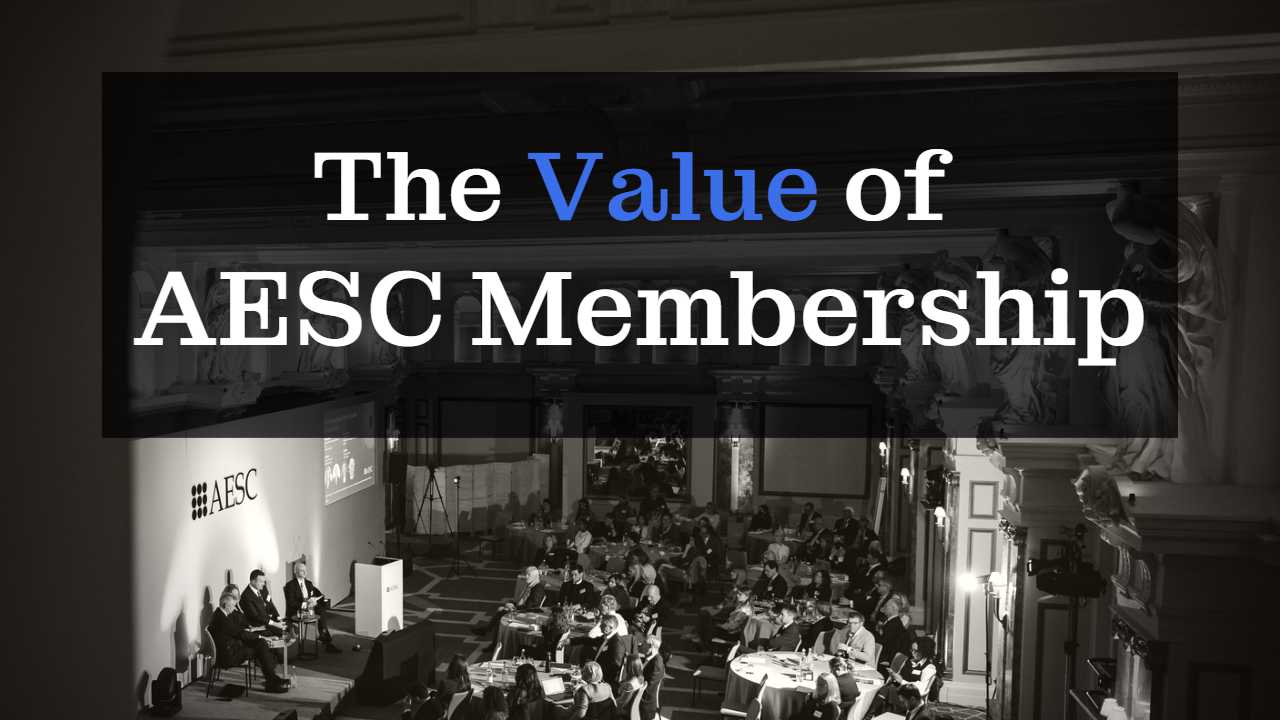
AESC Members represent a vetted, exclusive class of executive search and leadership advisory firms worldwide. Ranging in size from large global executive search and leadership advisory firms and networks to regional and boutique firms, AESC Members annually recommit to our stringent Code of Professional Practice. AESC is dedicated to strengthening leadership worldwide. We support our members through quality standards and professional practices; advocacy; insights and education. We raise the visibility of the profession among CEOs, Boards and other leaders, providing best practices and connection to best-in-class firms. World-class executive search and leadership consulting firms join AESC to demonstrate their commitment to quality. Business leaders worldwide retain AESC Members as trusted advisors to minimize risk and gain a competitive advantage. Learn more
An Executive Researcher, also commonly known as an Associate, Analyst or Search Coordinator, plays a vital role in the executive search process for both executive search firms and in-house talent acquisition teams. They lay the groundwork for a successful search by collaborating to develop a search strategy, finding and connecting with referral sources, generating a list of candidate names, qualifying candidates, managing gatekeepers and pitching the executive-level position. Additionally, they’re often the first in an organization to contact potential candidates, meaning they make the first impression for the executive search firm or company. To excel in executive research, we’ve identified four core characteristics one needs to stand out and contribute to a successful strategy: 1. Proactive Executive researchers are accountable for the search, meaning that the initiative they take in the early stages of a project can dramatically impact the outcome. Holding off on a search, waiting long periods of time between calling prospects, and not implementing a plan can lead to a project pileup and failed assignments. To avoid such a negative outcome, an executive researcher should be a self-starter and proactively drive the search strategy forward. They should be ready to dive into a search as [...]
When it comes to personal development and furthering your skills as a leader, peer-to-peer learning is a powerful tool that is often underestimated. Being open to sharing with and learning from people from different backgrounds and experiences allows you to view the world with a new perspective, increasing your confidence in your own abilities as a leader. Read the full article
When it comes to personal development and furthering your skills as a leader, peer-to-peer learning is a powerful tool that is often underestimated. Being open to sharing with and learning from people from different backgrounds and experiences allows you to view the world with a new perspective, increasing your confidence in your own abilities as a leader. Whether you're an experienced professional or just starting out, AESC's peer-to-peer learning programs provide a stimulating environment of support where you can develop new skills, expand your network, and advance your career. Below, find 3 benefits of peer-to-peer learning that can make a significant difference in your personal and professional growth. 1. Access to Different Perspectives Because AESC offers global online and in-person programs, you will learn alongside a diverse group of people from across the world. For example, our AESC | Cornell program features participants from Australia to Western Canada or South America. With this global reach, you can gain insight from individuals who possess different backgrounds and perspectives on the everyday practices within the profession. As one researcher from Steinbach & Partner in Germany put it, “Great opportunity to learn from experts about their personal best-practice experiences and sharing them [...]
New data shows men overwhelmingly dominate corporate leadership in the U.S. and globally, with women CEOs comprising only 5.4% of companies in the S&P Global Broad Market Index. The International Monetary Fund claims closing this gender gap could increase economic output by 35%. McKinsey found that gender diversity on executive teams is linked to above-average profitability. To address the issue, companies must focus on fixing systemic barriers and biases instead of asking women to change. Leadership advisor Jenna Fisher recommends implementing practices based on global research to promote and retain women in corporate leadership. Read the full article
Hiring, retaining, and promoting women to the highest levels sets companies on a more prosperous path.
At our 2022 Global Conference in London, we sat down with some of our members and asked them, "What's the best part of AESC membership?" Watch to listen to their responses.
BlueSteps provides executives with best-in-class career management solutions to assist them in advancing their careers, conducting a job search and increasing their visibility to quality executive search firms filling hundreds of thousands of executive and board roles each year. Part of the Association of Executive Search & Leadership Consultants (AESC), BlueSteps is the only career service that connects executives to the best executive recruiters worldwide. Increase your visibility to top executive search firms: Submit your resume or CV
How leading organizations take culture to the next level To weather constant disruption and the accelerating pace of change, organizations fight for top talent, drive innovation, and focus on culture. So why talk about belonging? Belonging may be the key to retention, risk-taking, and engagement that launches an organization past the competition. “Basically, Maslow was saying if you're starving to death, you're not going to be sitting around contemplating life—you’re going to be out searching for food. But what we now know is that Maslow may have missed the mark, and that belonging, the human need to connect and be part of the group around us may be, in fact, our most critical need.” Howard Ross, Founder, Udarta Consulting Howard Ross describes belonging as a shared sense of identity, destiny and values, a sense of interdependence, all of which allow people to feel fully able to be themselves. He says, “When people ask me for definition of terms, I like to say that if diversity is being invited to the dance and inclusion is actually being allowed to dance, belonging is when you actually have some say about the music. In other words, you are so completely a part of [...]

Global Headquarters
315 Madison Avenue, Third Floor
New York, New York 10017
United States
+1 (212) 398-9556
APAC Office
Level 1, 60 Martin Place
Sydney, New South Wales 2000
Australia
+61 499 972 181
EMEA Office
Avenue Louise 54
1050 Brussels
Belgium
+32 2 884 78 32
San Francisco Office
580 California Street, 12th Floor
San Francisco, California 94104
United States
+1 (415) 568-2100
Association of Executive Search and Leadership Consultants | Contact Us | Privacy Policy | Terms and Conditions | Sitemap | Copyright © 2026