
Executive Talent Magazine
Grant Hackett knows how it feels to stand alone at the edge of expectation. For years, the Australian swimmer dominated the 1500-meter freestyle, shattering world records and cementing his place in Olympic history. And when Hackett retired from swimming, he didn’t drift away from competition—he redefined it.
The connection between sport and business isn’t a metaphor in Hackett’s story—it’s a hard fact. The lessons he carries forward are not analogies, they are the inner mechanics of human and organizational performance: pressure, momentum, endurance and clarity.
Shaped by Pressure
When Hackett reflects on the pressure of walking out for an Olympic final, he describes it as unmatched. The eyes of the world, the weight of expectation, the unforgiving reality of a single race every four years.
“There is nothing like the pressure of walking out for an Olympic final when you’re the favorite,” Hackett reflects. “Once every four years, you get a chance. There are very few things that can emulate that sort of pressure.”
For Hackett, pressure isn’t something to be endured, it’s something to be embraced. “I enjoy it. I actually welcome it. I like the pressure,” he says.
His method for dealing with pressure is deceptively simple but ruthlessly effective. First, absolute clarity on what he’s going to do and how he’s going to start. Then comes the counterintuitive part: letting go completely.
“I stop thinking about it. Whatever happens now, happens. That letting go is something that a lot of people don’t do very well. They often continue to zone in more and more until it feels overwhelming.”
In business, this translates to a leader who can absorb pressure without transmitting it outward. “If you’re walking around as a leader who’s feeling the pressure all the time, people in the business feel that. They’re looking for calmness, direction, clarity. And if you don’t provide that, no one else will.”
Building Momentum
What Hackett discovered in sport is that success builds on itself. Momentum is fragile: it compounds when nurtured and collapses quickly when neglected. For him, this invisible force is as real as muscle memory.
“All of a sudden you could have a few key people leave from your team, hubris could creep into the business and complacency can set in, then all of a sudden momentum’s going the other way. And it is 10 times as hard to reignite that when you let it slip.”
In his company, the team runs on a philosophy of being “eternally dissatisfied.” Wins are celebrated, but never allowed to harden into complacency. It’s the business equivalent of his father’s advice: “Be number one, but train like you’re number two.”
The focus is always on what’s next, how to keep the energy alive, and how to ensure progress doesn’t stall. “Motivation doesn’t come first,” Hackett insists. “You act first. Then momentum creates motivation.”
The relationship between momentum and pressure is symbiotic. When you’re riding momentum, pressure becomes manageable. “If you feel like you’re on a roll, you’re having a lot of wins, your team’s feeling confident, and then you hit a bit of adversity, you’re able to absorb that a lot easier.”
Built to Endure
Behind Hackett’s rise, both in sport and in business, is the unglamorous truth of endurance. In the pool, it meant surviving pain that others couldn’t see.
Hackett recalls a pivotal race. He was just 16 years old, competing against an Olympic silver medalist, when his competitor tried to surge ahead. “I just hung on for dear life.” What his opponent didn’t know was how close Hackett was to breaking—if the silver medalist had held on another lap, the race might have been his. Instead, Hackett found just enough to push through, and “I broke him completely.” The lesson crystallized in that moment: often we give in at the most critical time, not knowing that sometimes winning lies just beyond our perceived breaking point.
In Hackett’s business, endurance meant years of building a brand that hardly anyone noticed, at first. He remembers investor roadshows where only a handful of people turned up, and product launches that barely registered. But persistence paid off. Revenue that once took twelve months, his firm now achieves in weeks.
“If you did not have the endurance, if you weren’t thinking you’re going to get there eventually, there is no way you would get through the pain,” he says with the matter-of-fact tone of someone who has learned to “sink into pain” as a strategic choice.
“Life is full of painful options,” he laughs. “Choose the one that takes you where you want to go.”
Clarity – the Force of Focus
There is one unexpected theme Hackett emphasizes: clarity. As an athlete, his purpose was simple: win. In business, the signals are more opaque. “Was it markets that lifted your business? Were you just in the right place at the right time, or did you do things really well?” This opacity creates its own form of pressure, which Hackett combats by imposing athletic-level clarity on business operations. Clear why, clear preparation requirements, clear success metrics. “Clarity does create a level of confidence. When you’re sure of what you’re doing, why you’re doing it, and what you need to achieve, that creates a sense of calmness.”
When crisis hits, clarity becomes the leader’s most powerful tool. “What can you control? Let’s focus on what we can control and let go of what we can’t control.”
Hackett cuts through noise and distraction with clarity. Clarity becomes the antidote to confusion and the anchor when storms hit. And, he believes, clarity fuels confidence—the quiet power that steadies leaders, reassures teams, and shapes resilient cultures.
The Champion’s Continuum
Hackett’s journey from Olympic gold to global markets reveals qualities that shape extraordinary performance. Pressure, momentum, endurance and clarity aren’t just athletic concepts borrowed for business. They’re fundamental characteristics of high performance in any domain.
“The principles and behaviors of high performance and success are exactly the same in any given environment,” he observes. “If you looked at the best musician, the best athlete, the best businessman, you’ll find the traits are identical. It’s just a behavioral approach towards your craft and your field.”
For leaders looking to elevate their performance, Hackett’s framework provides a practical architecture for excellence. Embrace pressure as fuel, guard momentum like your most valuable asset, build endurance for the long run, and above all, maintain the clarity that allows you to control what you can control and let go of the rest.
In a world that often treats leadership as an art form, Hackett reminds us it’s also a discipline—one that can be learned, practiced, and mastered by leaders willing to sink into the discomfort of sustained excellence.
As he puts it with characteristic directness: “Life’s hard. Choose your suffering.”
About Grant Hackett:
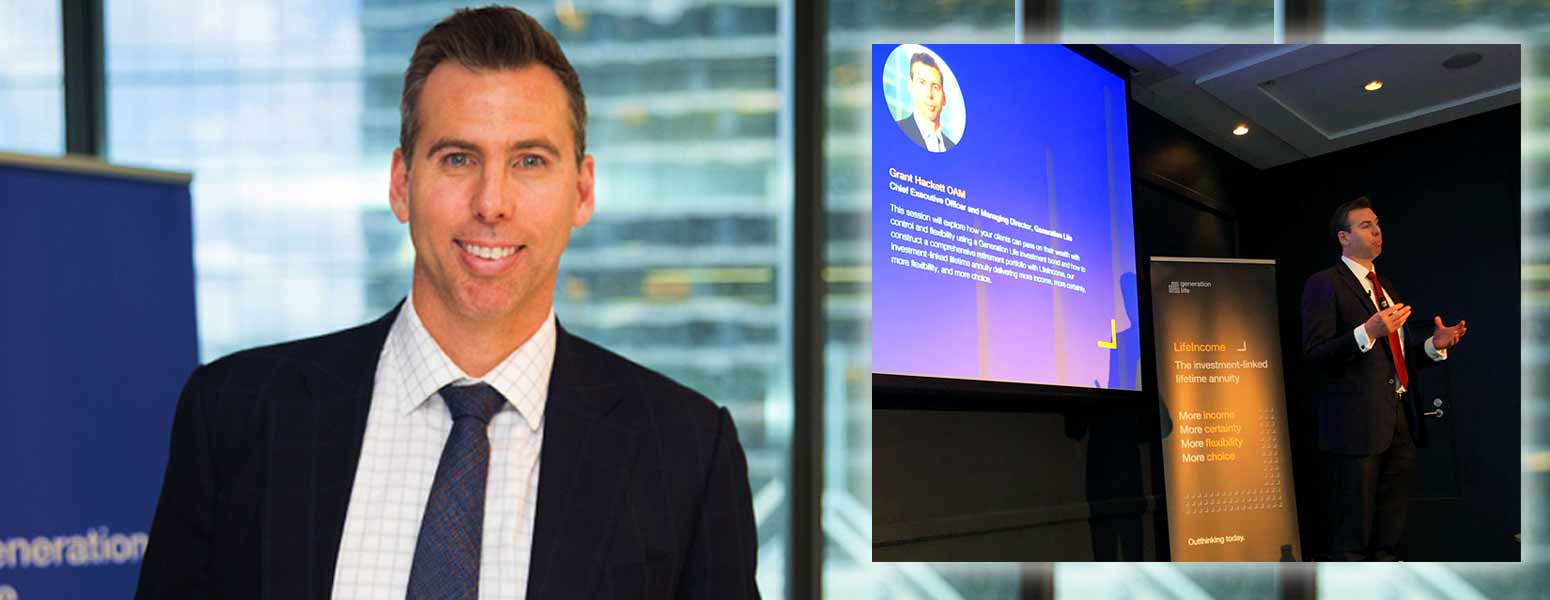
Grant Hackett OAM is one of Australia’s most celebrated athletes and business leaders. A three-time gold Olympic medalist and world record-holder in the 1500-meter freestyle, Hackett dominated international swimming for a decade. Since retiring from sport, he has built a successful career in finance and asset management, serving as CEO of Generation Development Group (ASX:GDG), a leading Australian financial enterprise.
