

Executive Talent Magazine
The corporate world is experiencing a fundamental shift in leadership philosophy, and chief human resources officers are at the forefront of proving a compelling business case. And that case is that empathy isn’t the opposite of high performance—it’s the pathway to it.
During the recent AESC Global Summit on Leadership in New York City, a panel of Chief Human Resources Officers (CHROs) echoed what moderator Gian Power, founder and CEO of TLC Lions, described as the essential challenge of our time. He said, “employees seem to be crying out for leaders to be more human.”
But as these seasoned executives revealed, being human in leadership isn’t about lowering standards or avoiding difficult conversations. Instead, it’s about recognizing that sustainable high performance requires a fundamentally different approach to managing people.
Redefining the Performance Equation
“Empathy is the new superpower,” underscored Matthew Breitfelder, Head of Human Capital at Apollo Global Management. “And empathy is what drives durable outperformance over a long period of time, which is what we’re here to do.”
This perspective represents a significant evolution from traditional command-and-control leadership models. As Stephanie Kramer, CHRO at L’Oreal North America, explained, modern leaders face “a strong tension between empathy and drive,” noting that “as CHROs, that’s one of the hardest things we have to do—leading with empathy and the drive— essential now and for our future.”
The solution, according to these executives, isn’t choosing one over the other but understanding how they work together. Breitfelder emphasized that “psychological safety, empathy, caring, challenge, feedback, and directness go together” because effective leadership requires genuine understanding of the individual first.
Solving the People Manager Lottery
One of the most significant challenges organizations face is what Power described as the “people manager lottery,” or the hit-or-miss experience employees have when assigned to new managers. For companies with thousands of employees, ensuring consistent, human-centered leadership across all management levels requires systematic intervention.
L’Oreal has addressed this challenge through what Kramer calls “the magic triangle” between HR, employees, and people managers. Rather than hoping middle managers would naturally develop people skills, the company invested in upskilling 3,000 people managers across their 13,000-person U.S. workforce.
“We’ve created accountability for becoming a stronger people manager,” Kramer explained. “It’s not just about engagement and a desire to be a good people manager, but on how to enable to their teams. The manager and the employee relationships can be, in part, fueled by HR but also independent and interdependent.”
Mari Sifo, former CHRO at Host Hotels, discovered that her organization’s service-oriented culture provided a foundation for human leadership, but managers needed guidance on translating care into effective performance management. “Our managers wanted to do good, they just didn’t know how sometimes,” she noted. The breakthrough came when managers could connect difficult conversations to service.
“If I don’t give that tough feedback, the consequences later on are too severe,” said Sifo.
The Cultural Accountability Imperative
The most successful organizations start by promoting human values. But more than that, they embed such values into performance systems with clear consequences. Lucien Alziari, now a senior advisor at Prudential Financial and formerly the company’s Chief Human Resources Officer, emphasized the point: “Every culture has its outliers – what do you do with these outliers? If you had to say the one thing that employees will notice most, it’s what happens to [them]?”
When asked what his organization did with toxic performers, Alziari responded with an unequivocal “Gone, gone, gone.”
This approach reflects a crucial understanding that authentic culture change requires more than aspirational messaging. As Lisa Buckingham, Chief Human Resources Officer at Vialto Partners, noted, organizations must focus on “getting the right people in the right job” and ensuring clear accountability around “who are you, what do you do, are you a good team member.”
Transforming Executive Search Partnerships
As human-centered leadership becomes a strategic priority, the relationship between CHROs and executive search partners is evolving in tandem. This deeper collaboration reflects a shared understanding that technical expertise is only part of what makes a leader successful. Cultural alignment, empathy, and the ability to build strong teams are just as critical—and harder to assess on paper.
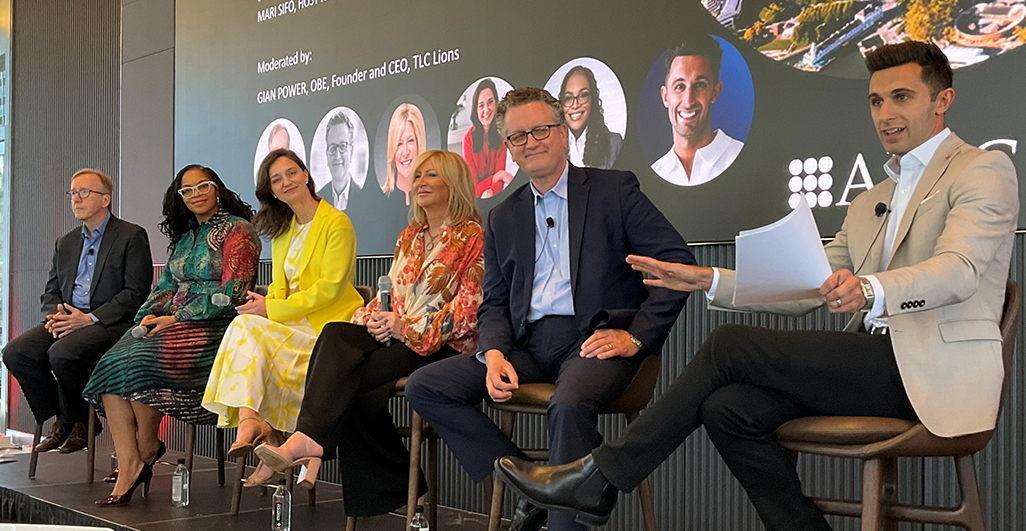
CHROs Matthew Breitfelder, Mari Sofi, Stephanie Kramer, Lisa Buckingham, Lucien Alziari and moderator Gian Power during their panel discussion presented at the AESC Global Leadership Summit on April 30, 2025.
“There isn’t a company here where we don’t desperately need people who are great collaborators, change agents and great culture carriers,” said Breitfelder. “That’s how you take technical skills and make them durable over time.”
To meet this challenge, CHROs are working more closely with their search partners to refine how leadership potential and cultural fit are evaluated. Lisa Buckingham described it as applying “the good colleague rule”—an approach that looks beyond résumés and references to understand how a candidate shows up as a teammate. “To be a good colleague, respect and trust are essential. That doesn’t mean everyone has to be friends outside of work, but being a good colleague is essential in business.”
Mari Sifo emphasized that the most effective partnerships go beyond placement. “The secret sauce of everyone here in executive search is the retained search,” she said. “And that retained search comes with an obligation of knowing (the hiring manager) and the organization well enough to know what we aren’t saying.”
This level of mutual investment—where search partners understand both the culture and the leadership context—allows CHROs to confidently identify candidates who can thrive in complex environments, not just check the boxes. The result is a more dynamic, trust-based model that reflects the demands of modern leadership.
Measuring What Matters
The shift toward human leadership requires sophisticated measurement approaches that go beyond traditional engagement surveys.
Organizations are implementing multiple feedback mechanisms to ensure accountability. L’Oreal replaced annual reviews with quarterly “connect conversations” that include employee feedback to their manager, creating a two-way dialogue around performance and development.
The measurement challenge extends to team dynamics as well. When audience members asked about protecting high-potential employees from ineffective managers, the panel emphasized using multiple data points including 360 reviews, engagement surveys, turnover rates, and team performance metrics to identify management problems early.
The Competitive Advantage of Consistency
Perhaps most importantly, these CHROs emphasized that human leadership isn’t a luxury reserved for good times—it’s most critical during challenging periods. Sifo’s organization maintained its people-focused approach even during the unprecedented disruptions of COVID. “We didn’t lay off. And so if we can weather the storm on something that no one else has experienced before, then we’re not going to become rattled and shift our strategy because of strong winds,” she said.
Breitfelder reinforced this long-term perspective. “At the end of the day, we’re an investment firm, so we’re interested in outperforming over a very long period of time,” he said. “Not just this quarter, not just next quarter, but over and over and over again.”
The Path Forward
The evidence from these industry leaders points to a fundamental truth. Organizations that invest in developing human-centered leadership capabilities aren’t choosing compassion over performance—they’re choosing a more effective path to sustainable success.
Lucien Alziari reinforced the importance of authentic leadership cultures built on action, not just rhetoric. “Culture has to be something that is experienced,” he said. “It’s not something that is just articulated in a memo. People know whether it’s real or not.”
As Power concluded, this represents “the most appropriate time in the world to delve into what it truly means to be human” in leadership. For CHROs and their executive search partners, the challenge and opportunity lie in building systems, processes, and partnerships that consistently identify, develop, and retain leaders who can deliver results through authentic human connection.
The organizations that master this balance—empathy with accountability, care with challenge, humanity with high performance—will attract and retain the best talent, and create the conditions for sustained competitive advantage in an increasingly complex business environment.
To continue these conversations and gain access to insights from global leadership experts, explore upcoming AESC Global Summits. These events bring together executive search and leadership consulting professionals with corporate leaders to share strategies, exchange ideas, and learn from leadership changemakers.
